 Skip to content

When newscasts fill up with images of war, it is natural for investors to feel uneasy. In times like these, markets begin to resemble the sea when the wind suddenly shifts: the surface ripples quickly, waves become unsettled, but this does not always mean that a prolonged and destructive storm is on the way.
Recent developments in the Middle East have brought geopolitics back to the forefront. For markets, however, the key issue is not just the news of the day, but the possibility that the conflict could turn into an energy shock. This is the actual link between geopolitical tensions and the real economy.
We have all, by now, learned a basic geography lesson: there is a key “bottleneck” in global shipping, the Strait of Hormuz, particularly for oil tankers. This strait remains the critical passage to monitor. Prolonged or even partial disruptions to the flow of oil and LNG (liquefied natural gas) could keep energy prices elevated, slow the disinflation process, and lead central banks to adopt a more cautious stance. In other words, the spark should not be assessed only for its immediate noise, but for whether it can ultimately reach the engine of the global economy.

In the baseline scenario outlined by several investment firms (many of which have released multiple analyses in recent days), the most likely outcome remains a limited conflict lasting a few weeks. However, a broader regional escalation cannot be ruled out and deserves close monitoring. This means that we are not facing a certain systemic crisis, but neither is this an episode to be dismissed lightly.
History suggests caution, not alarmism. Markets have often absorbed geopolitical shocks when growth, earnings, and financial conditions have remained solid. Risks become more serious when geopolitical tensions translate into higher energy costs, more persistent inflation, and weaker growth. It is a bit like driving: seeing clouds on the horizon is not enough reason to brake suddenly; what matters is understanding whether we are entering a passing shower or a truly slippery road.
Key Takeaways
- The key driver to monitor is energy: oil, LNG, logistics, and inflation expectations.
- Base case: a limited conflict and short-term volatility, not necessarily structural damage.
- Main risk: regional escalation and a more persistent energy shock.
- Portfolio approach: discipline, diversification, and quality; any tactical adjustments should be considered along the way only if conditions deteriorate structurally.
At this stage, we believe it is more useful to avoid emotional decisions. Not because emotions are wrong—they are human—but because markets tend to test investors precisely when the urge to react immediately is strongest.
We will continue to assess portfolios in light of individual objectives, keeping open the possibility of tactical adjustments along the way, but only if data confirm a more pronounced deterioration in inflation, interest rates, growth, and risk premia.
Scenarios and operational framework
Before taking action, it is useful to distinguish between noise and direction. The tables below are designed to do exactly that: to translate an emotionally charged event into a more structured analytical framework.
Scenario framework
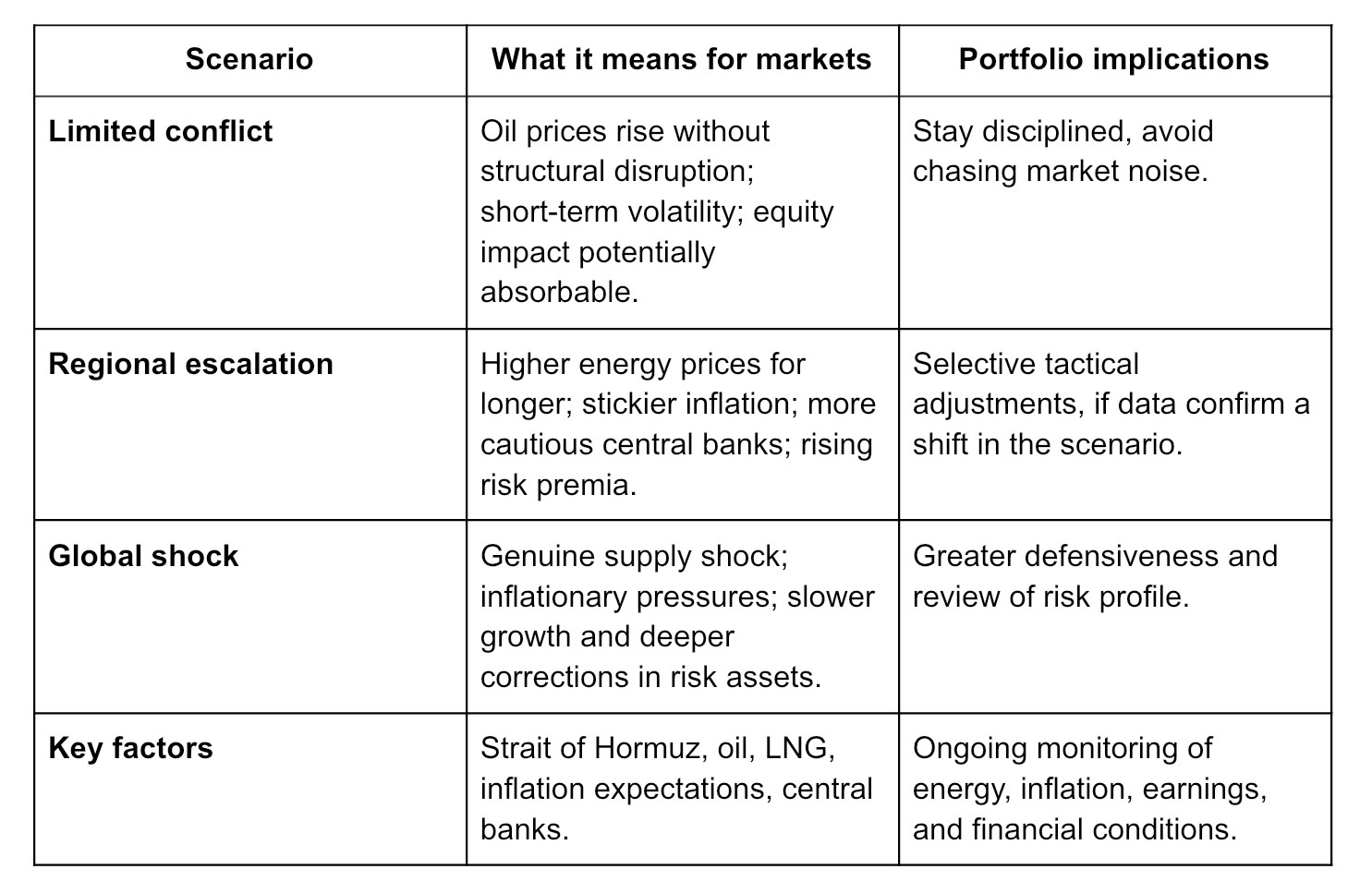
Scenario matrix and asset impact
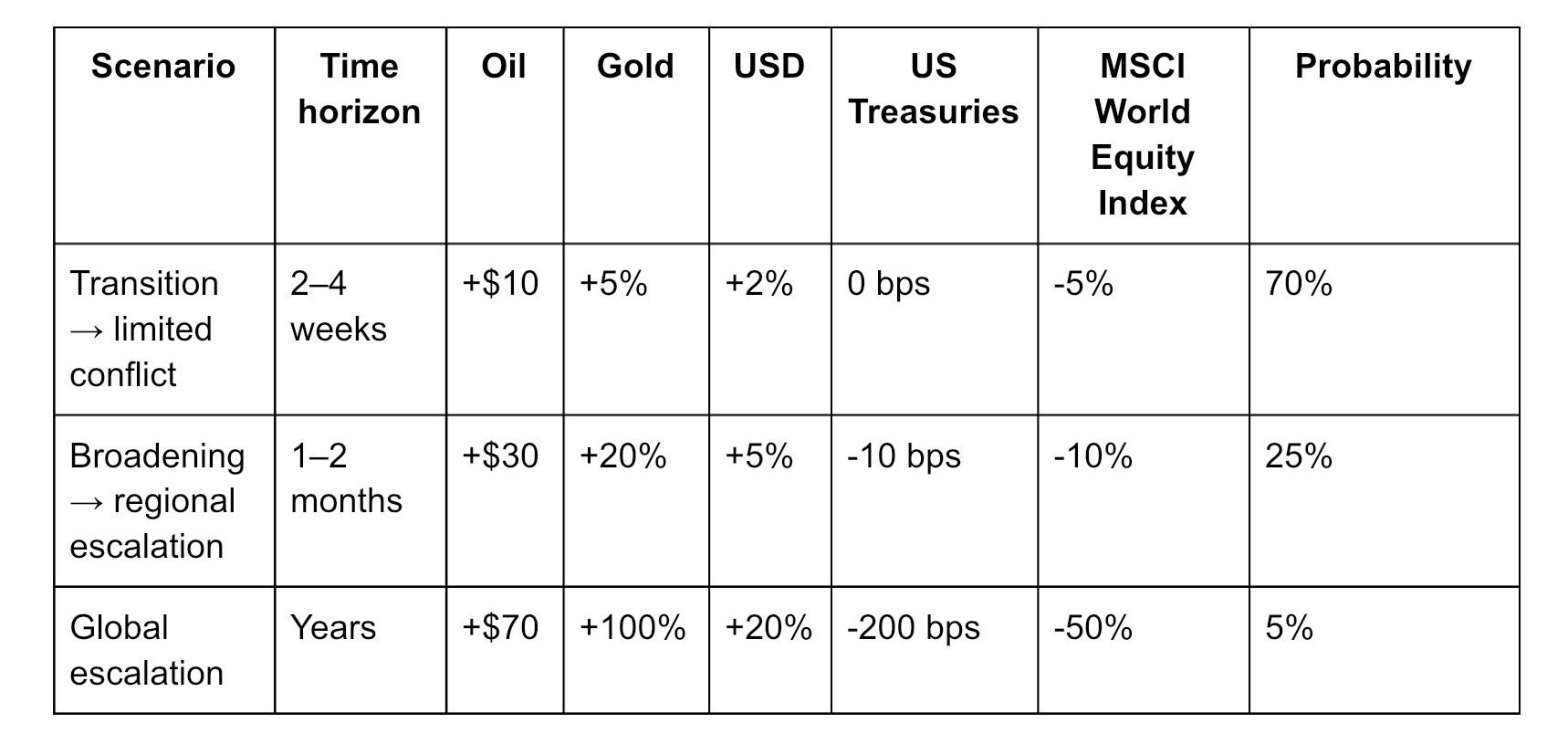
Summary: markets are not yet pricing in the worst-case scenario, but neither are they ignoring it. The situation remains manageable until the shock is primarily short-term and linked to logistics and energy. The outlook would change, however, if the shock were to become more persistent and affect inflation, interest rates and economic growth.
Simply put: we are nowadays in a phase where the market is watching the sky, not yet fleeing the harbor. But if the wind were to truly pick up, then it would make sense to adjust course gradually.
Morgan Stanley Analysis – S&P 500 after geopolitical events
To add more depth to these figures, it is useful to remember that Morgan Stanley does not reason in abstract terms, but he observes a long series of events that have shaped market history. The table below shows the performance of the U.S. S&P 500 index following geopolitical shocks over different time horizons days, months, weeks, and one year.

What does history teach us?
Geopolitical shocks have often generated short-term volatility, but not always lasting damage. The turning point is almost always the same: when the event truly affects economic fundamentals.
This is where an important and very human reflection comes into play, one that tends to emerge in moments of tension: “this time is different.” Sometimes it may be. But market history teaches us that our minds often assign greater emotional weight to the present than fundamentals ultimately justify over time.
A useful example is the Gulf War in 1990. At the time, the environment was highly tense, oil was at the center of attention, and there was a widespread perception that the situation could deteriorate in a much more prolonged way. Yet, despite strong initial volatility, markets eventually regained balance once it became clear that the shock was not permanently damaging the economic cycle.
A similar psychological pattern, albeit with different nuances, was observed more recently during Russia’s invasion of Ukraine in 2022: at first, the prevailing view was that the world had entered a new and irreversible normal; over time, however, markets began to distinguish between immediate emotional impact and truly persistent economic consequences.
What we monitor on the way
- Oil prices and flows through the Strait of Hormuz
- Inflation and interest rate expectations
- Earnings, growth, and credit spreads
- The potential need for selective tactical adjustments
Operational conclusion: No automatic reactions, no emotionally driven decisions. The foundation remains a portfolio construction aligned with individual objectives and time horizon; any tactical adjustments can be considered along the way, gradually and selectively, only if the scenario deteriorates in a more persistent manner.
In other words, in moments like these there is no need to rush: there is a need for method. And in wealth management, a sound method does not eliminate uncertainty, but it helps ensure we do not become hostage to it.
Francesco
When newscasts fill up with images of war, it is natural for investors to feel uneasy. In times like these, markets begin to resemble the sea when the wind suddenly shifts: the surface ripples quickly, waves become unsettled, but this does not always mean that a prolonged and destructive storm is on the way.
Recent developments in the Middle East have brought geopolitics back to the forefront. For markets, however, the key issue is not just the news of the day, but the possibility that the conflict could turn into an energy shock. This is the actual link between geopolitical tensions and the real economy.
We have all, by now, learned a basic geography lesson: there is a key “bottleneck” in global shipping, the Strait of Hormuz, particularly for oil tankers. This strait remains the critical passage to monitor. Prolonged or even partial disruptions to the flow of oil and LNG (liquefied natural gas) could keep energy prices elevated, slow the disinflation process, and lead central banks to adopt a more cautious stance. In other words, the spark should not be assessed only for its immediate noise, but for whether it can ultimately reach the engine of the global economy.
In the baseline scenario outlined by several investment firms (many of which have released multiple analyses in recent days), the most likely outcome remains a limited conflict lasting a few weeks. However, a broader regional escalation cannot be ruled out and deserves close monitoring. This means that we are not facing a certain systemic crisis, but neither is this an episode to be dismissed lightly.
History suggests caution, not alarmism. Markets have often absorbed geopolitical shocks when growth, earnings, and financial conditions have remained solid. Risks become more serious when geopolitical tensions translate into higher energy costs, more persistent inflation, and weaker growth. It is a bit like driving: seeing clouds on the horizon is not enough reason to brake suddenly; what matters is understanding whether we are entering a passing shower or a truly slippery road.
Key Takeaways
- The key driver to monitor is energy: oil, LNG, logistics, and inflation expectations.
- Base case: a limited conflict and short-term volatility, not necessarily structural damage.
- Main risk: regional escalation and a more persistent energy shock.
- Portfolio approach: discipline, diversification, and quality; any tactical adjustments should be considered along the way only if conditions deteriorate structurally.
At this stage, we believe it is more useful to avoid emotional decisions. Not because emotions are wrong—they are human—but because markets tend to test investors precisely when the urge to react immediately is strongest.
We will continue to assess portfolios in light of individual objectives, keeping open the possibility of tactical adjustments along the way, but only if data confirm a more pronounced deterioration in inflation, interest rates, growth, and risk premia.
Scenarios and operational framework
Before taking action, it is useful to distinguish between noise and direction. The tables below are designed to do exactly that: to translate an emotionally charged event into a more structured analytical framework.
Scenario framework
Scenario matrix and asset impact
Summary: markets are not yet pricing in the worst-case scenario, but neither are they ignoring it. The situation remains manageable until the shock is primarily short-term and linked to logistics and energy. The outlook would change, however, if the shock were to become more persistent and affect inflation, interest rates and economic growth.
Simply put: we are nowadays in a phase where the market is watching the sky, not yet fleeing the harbor. But if the wind were to truly pick up, then it would make sense to adjust course gradually.
Morgan Stanley Analysis – S&P 500 after geopolitical events
To add more depth to these figures, it is useful to remember that Morgan Stanley does not reason in abstract terms, but he observes a long series of events that have shaped market history. The table below shows the performance of the U.S. S&P 500 index following geopolitical shocks over different time horizons days, months, weeks, and one year.
What does history teach us?
Geopolitical shocks have often generated short-term volatility, but not always lasting damage. The turning point is almost always the same: when the event truly affects economic fundamentals.
This is where an important and very human reflection comes into play, one that tends to emerge in moments of tension: “this time is different.” Sometimes it may be. But market history teaches us that our minds often assign greater emotional weight to the present than fundamentals ultimately justify over time.
A useful example is the Gulf War in 1990. At the time, the environment was highly tense, oil was at the center of attention, and there was a widespread perception that the situation could deteriorate in a much more prolonged way. Yet, despite strong initial volatility, markets eventually regained balance once it became clear that the shock was not permanently damaging the economic cycle.
A similar psychological pattern, albeit with different nuances, was observed more recently during Russia’s invasion of Ukraine in 2022: at first, the prevailing view was that the world had entered a new and irreversible normal; over time, however, markets began to distinguish between immediate emotional impact and truly persistent economic consequences.
What we monitor on the way
- Oil prices and flows through the Strait of Hormuz
- Inflation and interest rate expectations
- Earnings, growth, and credit spreads
- The potential need for selective tactical adjustments
Operational conclusion: No automatic reactions, no emotionally driven decisions. The foundation remains a portfolio construction aligned with individual objectives and time horizon; any tactical adjustments can be considered along the way, gradually and selectively, only if the scenario deteriorates in a more persistent manner.
In other words, in moments like these there is no need to rush: there is a need for method. And in wealth management, a sound method does not eliminate uncertainty, but it helps ensure we do not become hostage to it.
Francesco